

There are many ways and many levels at which we can act to maintain, improve or restore our health.
Which of these paths we choose depends on our overall condition as well as our preferences or aversions. Someone is more ready to deal with nutrition, someone with sports, someone with mental work.
In the next series, HEALTH FIRST, I will talk about small changes that we can all implement, which are simple and understandable, accessible to everyone, and which work wonders for our health.
Another important aspect of health is a HEALTHY DIET.
Food is our medicine when we use it adequately and in balanced quantities. In order for that to happen, it is advisable to follow certain rules so that what we take into ourselves is for our benefit.
„Let your food be your medicine and your medicine your food.“ – Hippocrates
There are many testimonies that confirm that we can recover and heal with food
How to respect holism in nutrition
Where did the food come from, what ingredients was it made of, what was the soil it was growth in, in what conditions was it stored and how long before it reached your table?
What protective measures were used during cultivation? How organic, real, treated? Was she growing outside, in a greenhouse or special farm with artificial light and always exposed to a chemical supply of food for growth?
How was it prepared, under what conditions?
How was it consumed? – All these are the items we talk about when we say that food is medicine and that we can heal ourselves with it.
Is it overly genetically modified so we only have perfect, huge, luscious fruits with little bitterness or acidity because that’s not what attracts buyers? Or what catches your attention?
There are many questions to which we need to find answers in order to extract all the usefulness that lies from one of the default categories. And it is good that it is so. By doing so, we really focus on what we dedicate ourselves to. We choose the best for our health, for our growth and development, for the functions of our organism.
Sometimes it’s hard to be so focused. Or impossible due to the obligations we have during the day. My attempt is to give you a couple of guidelines that will always keep you on the good side, enhance the good effect and minimize the harmful effects on our body that come from inadequate food.
We will discuss the topic of which form of nutrition you will choose for yourself in one of the following texts, because it really requires a lot of attention.
Principles to be respected
Avoid the microwave oven: It works on the principle of radiation (same as mobile phones, 2.5GHz) where the water molecules in the food are stimulated to move at a high frequency, which causes heating. In this way, water loses its energy quality, its structure changes and water and food does not meet our needs.
Also, the plastic material from package releases softeners into the heated food or liquid that we later ingest into the body. This also brings plastic into the body.
It is best to use gas as a heating source because it is the most natural and has no electromagnetic radiation.
Choose fresh foods. Seasonal, local foods that take the shortest path from field to table have the most biophotons – tiny light particles that give us clean energy for life. Our cells love them and use them most easily. Chewing the freshest, raw products slowly is the way to bring the most life energy available in food into yourself.

Drink plenty of fresh water: Spring water is best, but if you don’t have it, you can use a jug with a good filter (Brita, Aquafor). The taste of drinks prepared with filtered water is much nicer and fuller.
Water is a special food and will be discussed more in the next blog. The importance it has for us is probably underestimated because we rarely encounter a real lack of good, quality water.
Limiting processed foods
Reduce your intake of ready-made meals: Although they are a fast option, ready-made meals are full of artificial flavor enhancers, sugar, too much salt and are often made from compostable ingredients.
Not infrequently, the addition of spices masks the smell and taste of food that has already begun the process of rotting.
Limit flavor enhancers: Avoid ingredients with glutamates, many E-numbers, white sugar or bad sweeteners that increase the glycemic index. When we use them we just get used to strong tastes and the body asks for more.
Reduce the use of refined oils: Use cold-pressed oils and high-value MCT (Middle-Chain-Triglyceride) oils. Sunflower oil should be avoided as much as possible. Pay attention to the burning points of oil or butter. Never go to the point where it starts to burn and smoke, then it only has a harmful effect on the body.
Natural spices and salt
Use fresh or dry herbs: Pepper, cayenne pepper, turmeric, curry, cinnamon, cloves, cumin, oregano, mint, thyme, marjoram, parsley, celery – all these spices give food a rounded taste and stimulate processes in the body and help digestion.
Salt in moderation: Use rock or sea salt without additives (which prevent salt from clumping). Himalayan salt is great for everyday use. Buy the coarse one, in the mill, not pre-ground, because the quality and percentage of purity is higher.
Choosing organic foods
Biologically grown foods: They contain more minerals and vitamins necessary for complete processes in the body than those grown on depleted soil treated with chemicals.
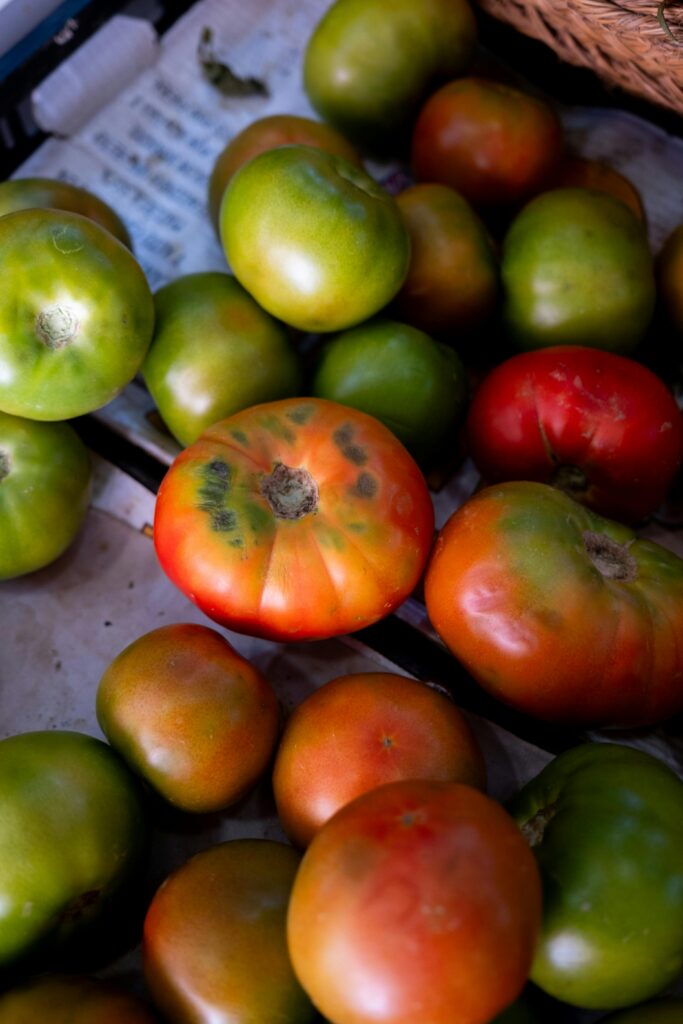
When shopping at the market, look for and choose fruit varieties that don’t look completely uniform and that have a wide variety of shapes. so to speak, falls. It is most likely that they are old varieties, not hybrids. They are stronger, more resistant and not treated with a lot of agents to give a good yield.
An alternative to expensive organic foods: If you can’t afford completely organic food because you’re feeding the whole family, see what foods you can get from home farming.
One good way to extract harmful chemicals from some foods is to soak (green, leafy) vegetables and fruits in a solution of water and baking soda (without aluminum). Let them rest for 10-20 minutes and then process them further.
I wash all large fruits, but also those that I peel off (eg watermelons, melons, oranges, lemons…) with cold water and a brush. This frees them from the remains of protective waxes and chemicals.
Conclusion
“Less is more” principle: The taste, satiety and usability of an organically grown fruit is greater and better than those that are not. It is better to eat a small organically grown apple from the neighborhood than a banana from Ecuador or an avocado from Israel. It’s okay to allow yourself variety, but you shouldn’t overdo it just because something is in fashion.
Be in harmony with your body and follow what it really needs and what you can give up. His wisdom will lead you to the ideal state.
Leave a Reply